Travel Tech Guide · 2026
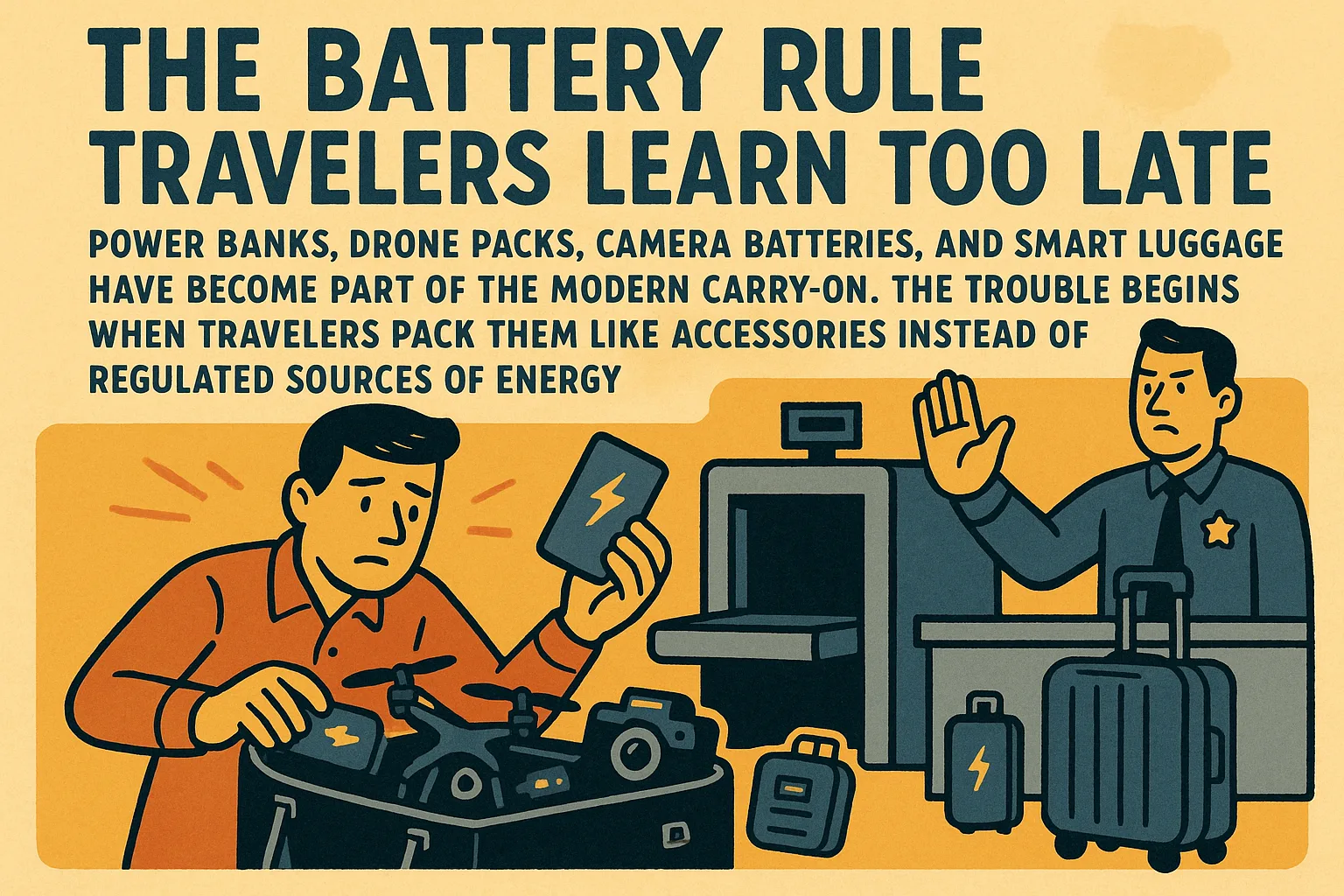
Power banks, drone packs, camera batteries, and smart luggage have become part of the modern carry-on. The trouble begins when travelers pack them like accessories instead of regulated sources of energy.
Updated for 2026 passenger guidance · Kansai Fixer
A few years ago, flying with a charger felt simple: toss a power bank into whatever pocket had room and move on. Today, that same casual habit can slow down a security line, force a repack at the gate, or leave an expensive battery behind. The rule itself is not complicated. The part people miss is that airlines do not judge lithium-ion batteries by the biggest marketing number on the box. They look at watt-hours, abbreviated Wh.
That distinction matters because Wh measures energy. A battery’s energy rating is what tells airlines whether it sits comfortably inside the usual allowance, whether it needs carrier approval, or whether it should not be on a passenger aircraft at all. The Federal Aviation Administration’s passenger guidance allows lithium-ion batteries up to 100 Wh, places 101–160 Wh batteries in a stricter category requiring airline approval, and forbids batteries above 160 Wh for ordinary passenger use. The Transportation Security Administration also treats spare lithium-ion batteries, including power banks and charging cases, as carry-on only items.
Before You Fly
Assume power banks, spare camera batteries, drone batteries, and loose rechargeable packs belong in your carry-on.
Find the Wh rating printed on the battery or device. If the Wh rating is missing, use voltage and amp-hours to calculate it.
Treat 100 Wh as the normal ceiling for most consumer travel tech.
Ask the airline before traveling with batteries rated from 101 Wh to 160 Wh.
Do not pack damaged, swollen, overheated, or recalled batteries.
The one-sentence rule
Carry lithium batteries where the crew can reach them, and make every decision from the Wh rating, not the mAh number.
Why the Rule Is About Watt-Hours, Not “Battery Size”
Most travelers recognize mAh because it is the number brands advertise on portable chargers. A 10,000 mAh power bank sounds modest; a 30,000 mAh unit sounds reassuringly robust. But mAh measures charge capacity, not the full energy picture. Without voltage, it does not tell an airline how much energy the battery contains.
Wh combines capacity and voltage. That is why the FAA and IATA guidance centers on watt-hours for rechargeable lithium-ion batteries. IATA’s 2026 passenger guidance says lithium-ion battery limits primarily depend on the Wh rating and notes that lithium-ion batteries are required to have the Wh rating marked on the outside of the battery case. If staff cannot verify the Wh rating from the battery or documentation, the operator may refuse carriage.
The number that matters at the airport is not the one that makes a charger sound powerful. It is the one that tells the airline how much energy is inside.
mAh, Wh, Watts, and USB-C PD: What the Label Is Really Saying
A battery label can feel like a small electrical-engineering exam, but the practical reading is straightforward once the terms are separated.
Label term | What it means | Why travelers confuse it |
|---|---|---|
mAh | Milliamp-hours. A measure of charge capacity. | It is often the largest number on the box, so it looks like the airline limit even though it is not. |
Wh | Watt-hours. A measure of stored energy. | This is the value airlines use for lithium-ion battery limits, but it is sometimes printed in small type. |
W | Watts. The rate at which power is delivered or drawn. | A 65 W or 100 W charger may charge quickly, but that number does not tell you the battery’s allowed energy rating. |
PD | USB Power Delivery. A protocol that lets devices negotiate voltage and current. | PD tells you about charging behavior, not whether the battery fits the airline threshold. |
For airport purposes, Wh answers the permission question. Watts and PD answer the performance question. A fast charger can still be small enough to fly, and a slow-charging battery can still be too large. The label has to be read in the right order.
The 100 Wh and 160 Wh Thresholds in Real Travel Terms
For most travelers, the key numbers are 100 Wh and 160 Wh. The first is the familiar ceiling for standard personal lithium-ion batteries. The second is the upper edge of a special-approval zone for larger batteries, often seen with professional audio-visual gear, extended laptop batteries, and certain higher-capacity packs.
Battery rating | What it usually means | Traveler action |
|---|---|---|
0–100 Wh | Common consumer electronics and many power banks. | Carry on, protect from damage and short circuit, and keep the label accessible. |
101–160 Wh | Larger batteries sometimes used for professional equipment. | Contact the airline in advance. U.S. guidance allows up to two larger spares only with air carrier approval. |
More than 160 Wh | Too large for normal passenger baggage under standard guidance. | Do not bring it as ordinary travel gear. Look into cargo or specialized transport rules instead. |
When Wh is not printed, you can calculate it if the label gives voltage and capacity. The FAA’s formula is simple: multiply volts by amp-hours. For milliamp-hours, divide mAh by 1,000 first.
Wh = V × Ah
If the label shows mAh instead of Ah: Wh = V × (mAh ÷ 1,000)
Using a common 3.7 V lithium-ion nominal voltage, a 20,000 mAh power bank is roughly 74 Wh. A 27,000 mAh power bank is roughly 100 Wh. A 30,000 mAh model can land around 111 Wh, which is why the printed Wh rating matters more than a mental shortcut.
Why this deserves attention
UL Standards & Engagement reported that thermal runaway incidents averaged two per week in 2024, with nearly one in five incidents causing a significant passenger disruption.
Source: UL Standards & Engagement, Lithium-Ion Battery Incidents in Aviation: 2024 Data Review
Why Carry-On Is the Safer Place
The reason behind the rule is not bureaucracy. It is access. Lithium-ion batteries can enter thermal runaway when damaged, overheated, exposed to water, overcharged, improperly protected, or affected by manufacturing defects. In the cabin, a smoking or overheating device can be seen, reached, and handled by trained crew. In a checked bag, the same event is harder to detect and harder to reach quickly.
This is why power banks, spare lithium-ion batteries, phone charging cases, external battery packs, and loose rechargeable cells should be packed as cabin items. If your roller bag is gate-checked, remove those batteries before the bag leaves your possession. A gate-check is still a checked bag once it disappears down the jet bridge.
How to Pack Power Banks, Camera Batteries, and Drone Packs
The best packing system is not elaborate. It is deliberate. Put batteries where they can be shown, remove them quickly if a bag is checked, and prevent terminals from contacting keys, coins, tools, or loose cables.
Make a battery inventory. Count power banks, camera batteries, drone packs, laptop spares, charging cases, and smart-luggage batteries.
Confirm each label. Look for Wh first. If you only see mAh and V, calculate Wh before leaving home.
Separate and protect. Use original packaging, individual sleeves, terminal covers, or small pouches.
Keep large batteries visible to yourself. If a pack is near 100 Wh or above, do not bury it beneath clothing.
Watch heat and swelling. A battery that is hot, bulging, leaking, or behaving strangely should not travel.
Drones and cinema cameras deserve special attention because they often travel as systems. A drone may have one battery installed and two or three spares. A mirrorless or cinema kit may include different battery models with different Wh ratings. Do not assume every pack in the same bag has the same allowance.
Smart Luggage, Trackers, and the Gate-Check Problem
Battery-powered luggage adds another layer of confusion. Smart luggage may include removable power banks, electronic locks, tracking systems, weight sensors, or motorized features. IATA’s 2026 passenger guidance treats smart luggage with integrated lithium batteries as portable electronic devices, while also distinguishing baggage tags and GPS tracking devices as their own category.
The practical rule is to know what is inside the bag before an airline employee asks. If the bag has a removable power bank, remove it before checking the bag. If it has a small tracker, confirm the battery type and airline policy. If it is rideable or motorized luggage, do not assume it qualifies like an ordinary carry-on; many small vehicles have batteries that exceed 160 Wh.
What to Do If You Are Unsure at the Airport
If you are already in the terminal and cannot confidently identify the rating, slow down and read the label before joining the security line. Look for Wh, V, Ah, or mAh. Search the manufacturer’s documentation only if you can match the exact model number. If the battery is unmarked, damaged, or too large to verify, do not try to talk your way through the checkpoint. That is how a useful travel accessory turns into a delay.
For international trips, also check the airline’s own policy. The baseline guidance is increasingly familiar, but carriers can add stricter instructions, especially around using or charging power banks in flight. Some airlines now require portable chargers to remain visible while in use, and others restrict power-bank use entirely during the flight. Your safest assumption is that carry-on permission and in-flight use are separate questions.
Where Kansai Fixer Fits In
Airport stress rarely comes from one thing. It is the combination of timing, luggage, security, boarding, and the small surprise you did not build time for. Kansai Fixer helps make the ground side of travel calmer by coordinating airport transfers with clear communication and realistic timing, so travelers have room to handle a repack, a delayed bag, or a last-minute airline question without feeling rushed.
Learn more about Kansai Fixer airport transfers and Colorado travel support.
The Pre-Flight Battery Routine
Two minutes at home can prevent ten stressful minutes at the airport. The routine is simple enough to become part of the same checklist as passport, wallet, and medication.
Charge only the devices and battery packs you actually need.
Remove damaged or swollen batteries from your kit.
Verify Wh ratings, especially for power banks over 20,000 mAh.
Place spare batteries and power banks in carry-on baggage only.
Protect exposed terminals from short circuit.
Keep larger or unusual packs accessible in case staff ask to inspect them.
Before gate-checking a bag, remove all spare lithium batteries and power banks.
The Bottom Line
The battery rule most travelers learn too late is not really about batteries. It is about reading labels before the airport makes the decision for you. Carry lithium batteries in the cabin. Protect them from damage and short circuit. Use Wh as the deciding number. Ask the airline before traveling with anything between 101 Wh and 160 Wh. Leave anything damaged, unverified, or oversized out of your luggage.
Modern travel depends on devices, and devices depend on batteries. Treat those batteries like part of your travel documents: checked before departure, easy to find, and never left to chance.
Frequently Asked Questions
Can I take a power bank on a plane?
Usually, yes. A power bank is treated as a spare lithium-ion battery, which means it belongs in carry-on baggage, not checked luggage. The key number is the Wh rating.
What is the normal power bank limit?
Most passenger guidance uses 100 Wh as the standard limit for lithium-ion batteries. Batteries from 101 Wh to 160 Wh require airline approval, and ordinary passenger batteries above 160 Wh are generally forbidden.
How do I convert mAh to Wh?
Divide mAh by 1,000 to get Ah, then multiply by voltage. For example, 20,000 mAh at 3.7 V is 20 Ah × 3.7 V, or about 74 Wh.
Can I pack spare camera or drone batteries in checked luggage?
No. Spare lithium batteries should travel in carry-on baggage only and should be protected from short circuit. Installed batteries may have different rules, but the safest planning habit is to keep spares with you.
What if my carry-on is gate-checked?
Remove spare lithium batteries and power banks before handing over the bag. Gate-checked luggage is no longer accessible in the cabin.
Can I use my power bank during the flight?
Maybe. Carry-on permission is not the same as in-flight use permission. Some airlines allow use, some require visibility, and others restrict charging or power-bank use, so check your airline before boarding.
Sources and Further Reading
Federal Aviation Administration: PackSafe — Lithium Batteries
Federal Aviation Administration: Batteries Carried by Airline Passengers FAQ
Transportation Security Administration: Lithium batteries with more than 100 watt hours
IATA: Passengers Travelling with Lithium Batteries — 2026 Guidance Document
UL Standards & Engagement: Lithium-Ion Battery Incidents in Aviation, 2024 Data Review